
PlansLead-to-Revenue System

Lead-to-Revenue System

Build the operating systembetween lead generation and revenue.

Verlux connects tracking, CRM, lead handling, automation and revenue data so marketing does not stop at the form submission — and the business can see what happens next.

Keep your current CRM or media team when they already work. Verlux connects the missing operating layers instead of forcing unnecessary migration.
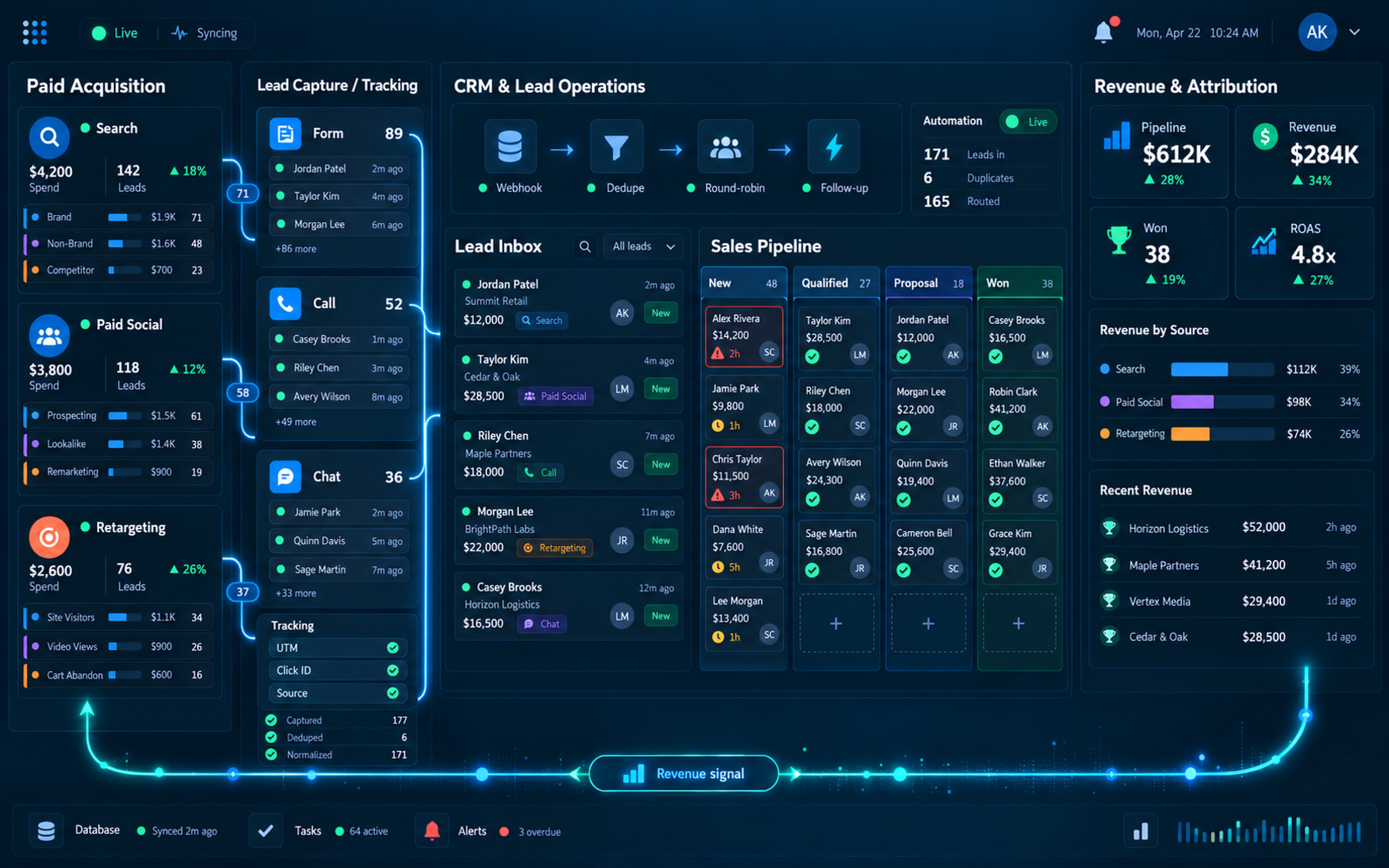
See how Verlux delivers the system

Lead-to-Revenue operating view

Acquisition → operations → revenue
Connected loop
Lead-to-Revenue system visual showing acquisition connected through tracking, CRM and lead operations to pipeline and revenue feedback.
The system follows the lead beyond acquisition so downstream quality, pipeline and revenue can feed future growth decisions.
Build & Launch$3,500 to $6,000one-time
After launchFrom $1,500/month

System Care or Managed System

Paid acquisitionOptional

Verlux can manage ads, but the system does not depend on it.

What gets built

Connect the handoffsthat decide whether leads become revenue.

Verlux builds the operating connections that preserve context, create ownership and return downstream outcomes — without adding software simply for the sake of adding software.

Build scope

Five connected operating layers
Outcome-led
  1. 01

    Preserve origin

    Tracking & acquisition context

    Keep source, campaign and lead identity connected when demand enters the business.

    Business effectKnow which acquisition created the lead.
  2. 02

    Create ownership

    CRM & lead record

    Use the existing CRM when it works, or deploy Verlux CRM when a suitable operating layer is missing.

    Business effectOne record with context, owner and status.
  3. 03

    Move the lead

    Routing & follow-up

    Define assignment, next actions, reminders and escalation around the way the team should actually work.

    Business effectFewer leads disappear between handoffs.
  4. 04

    See progression

    Pipeline & qualification

    Connect lead status to real sales progression instead of treating every form submission as equal.

    Business effectSee which leads become meaningful opportunities.
  5. 05

    Close the loop

    Revenue feedback

    Feed qualified lead, pipeline and customer outcomes back into reporting and future growth decisions.

    Business effectOptimize for business value, not only cheap leads.
Context that should surviveThe lead can move between tools without resetting the story.
  • Source
  • Campaign
  • Lead ID
  • Owner
  • Status
  • Pipeline
  • Revenue
Existing stack works

Keep it and connect what is missing.

A suitable CRM, analytics stack or acquisition team does not need to be replaced just because Verlux is building the wider system.

Operating layer is missing

Deploy the missing foundation.

When no suitable CRM or lead-operations layer exists, Verlux can deploy the reusable core required to make the wider journey work.

Downstream data exists

Return outcomes to growth decisions.

Where reliable data supports it, qualified lead, pipeline and revenue signals can inform acquisition and operating improvements.

Data, AI & automation

Use downstream evidenceto decide what should change.

Data shows what happened. AI helps organize messy context. Human judgment decides what matters. Automation executes repeatable actions after the decision is clear.

Decision loop

Evidence → interpretation → action → measurement
Human controlled
  1. 01

    Evidence

    See what actually happened

    Combine acquisition, lead, sales and revenue signals so the business can judge more than clicks or form submissions.
    • Source + campaign
    • Lead quality
    • Pipeline + revenue
  2. 02

    Interpret

    Use AI where context is messy

    AI can help summarize notes, classify free text and surface repeated patterns that would be slow to review manually.
    • Summaries
    • Intent
    • Objections
  3. 03

    Decide

    Keep judgment human

    Verlux combines evidence with business context before deciding what deserves attention or what should change.
    • Priority
    • Root cause
    • Approval
  4. 04

    Execute

    Automate the repeatable work

    Once the action is clear, predictable tasks can run through routing, reminders, synchronization and approved workflows.
    • Routing
    • Reminders
    • Sync
  5. 05

    Measure

    Check whether the change worked

    The result returns to the same system so the next decision can use downstream evidence instead of assumptions.
    • Before / after
    • Qualified rate
    • Revenue
Automation handles what is predictable. AI helps with what requires interpretation.
Structured data example

Cheap leads can hide expensive outcomes.

Decision example
MetaLower CPL
Leads
180
CPL
$25
Qualified
19
Customers
1
GoogleBetter outcome
Leads
100
CPL
$40
Qualified
42
Customers
4

Decision changes:compare acquisition using qualified leads, pipeline and customers — not CPL alone.

Conversation intelligence

Unstructured conversations can become usable signals.

AI-assisted
Conversation setNotes · enquiries · lost reasons
Price objectionRepeated frequently
UrgencyHigher in strong-intent leads
Lost reasonFollow-up delay repeats
Acquisition issuePaid Media
Operating issueManaged System
Broken workflowSystem Care

Pricing estimator

Build once.Then choose what Verlux keeps owning.

Configure ongoing system responsibility and optional Paid Media Management. The calculator separates Verlux fees from software and advertising spend.

01

Ongoing system responsibility

What should Verlux own after launch?

Choose ongoing system support
02

Acquisition responsibility

Should Verlux manage paid media too?

Choose whether Verlux manages paid media
03

Media budget

How much advertising spend should we model?

Paid directly to ad platforms
/ month

Final scope follows the System Audit.Paid media above $75,000/month uses custom management pricing.

Scope clarity

Know which fee ownswhich kind of work.

Building, repairing, improving and running campaigns are different responsibilities. The commercial scope should stay as clear as the operating scope.

Responsibility rules

Match the work to the correct commercial scope
Explicit scope
  1. 01
    WhenA new system or major implementation needs to be built
    Verlux scopeBuild & Launch

    Diagnose, design, connect, test and launch the agreed implementation.

  2. 02
    WhenSomething in the agreed live system is broken or incorrect
    Verlux scopeSystem Care

    Maintain, repair and recover what should already be working.

  3. 03
    WhenThe live system works, but new evidence justifies improvement
    Verlux scopeManaged System

    Prioritize and execute proactive operating improvements.

  4. 04
    WhenPaid campaigns need planning, testing or optimization
    Verlux scopePaid Media Management

    Manage acquisition and campaign optimization inside the media scope.

Paid Media formula

The management fee scales with media spend.

Ad spend separate
$0–$30k spend$750 + 8%
$30k–$75k spend$1,650 + 5%
Above $75kCustom
Cost separation

Not every operating dollar is a Verlux fee.

VerluxService feesBuild, ongoing system responsibility and Paid Media Management when selected.
Software providers$500–$2,000/monthEstimated tools and usage. Existing suitable tools can stay.
Ad platformsYour media budgetPaid directly to Google, Meta or other advertising platforms.

Start with a System Audit

Before we build,we diagnose where the revenue path breaks.

Verlux reviews how leads enter your business, how they are tracked and handled, what happens inside the CRM and where visibility is lost between acquisition and revenue. From there, we define the right system scope.

Start a System Audit

Less manual work. Fewer lost leads. Clearer revenue data.

What the audit starts withContext before recommendation
  1. 01
    Funnel

    How leads enter and move through the business.

  2. 02
    Stack

    Tracking, CRM, spreadsheets and automation already in place.

  3. 03
    Bottlenecks

    Where ownership, visibility or manual work starts to break.